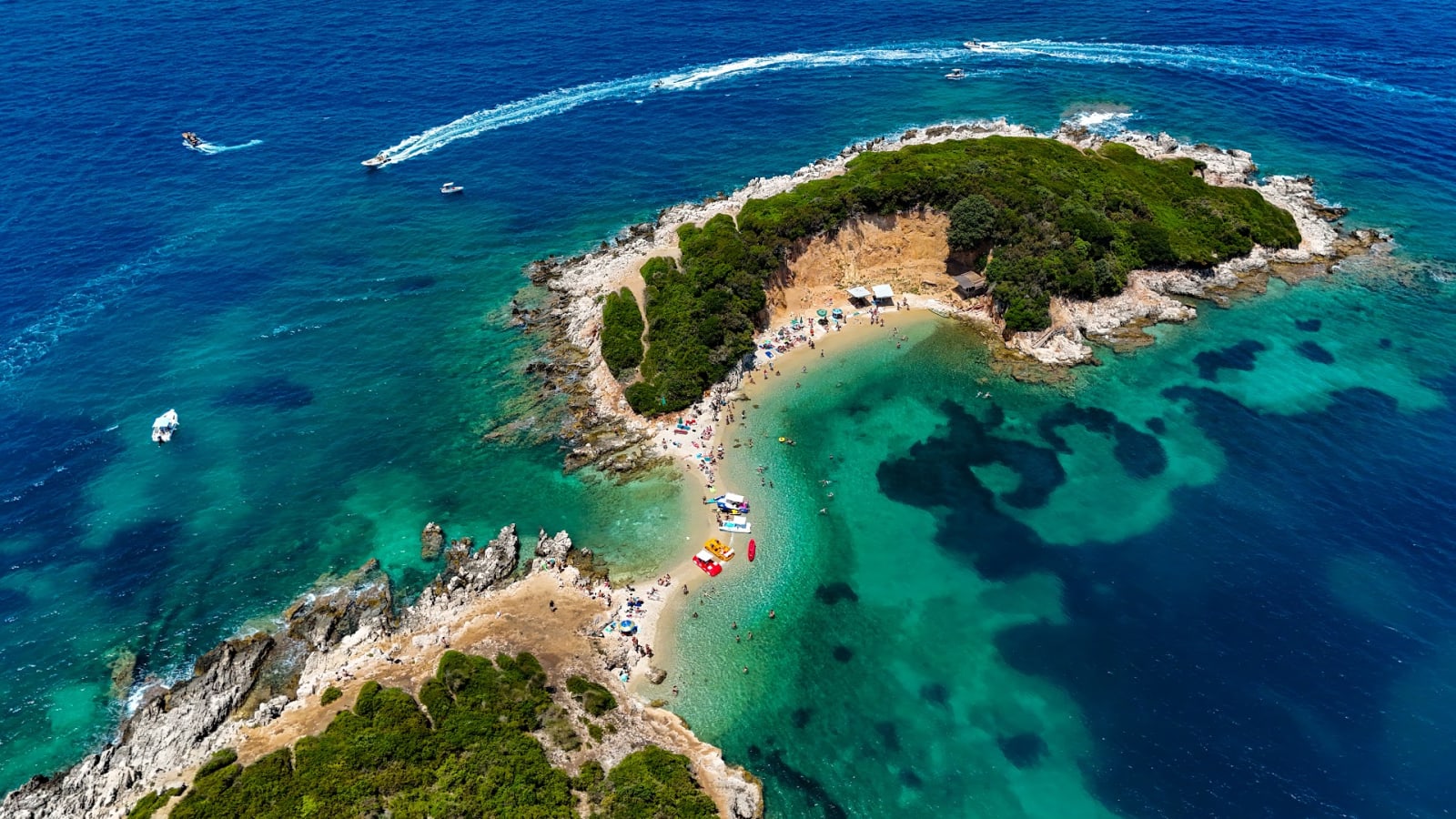
Saranda sits at the southern end of the Albanian Riviera, facing Corfu across the strait, and a great deal lies within a day of it. To the south is Butrint, the ancient city on its lake. Inland are the Blue Eye spring and the stone town of Gjirokastër. Across the water is Corfu, and to the north the coast road climbs past the beaches of Lukovë and Borsh towards Himarë.
This guide takes the trips one by one, with how to reach each by bus, car, tour or boat and what to know before you go. It gives distances only where an official source or the operator states them, and no driving times beyond the one Butrint's own foundation publishes; allow for summer traffic on any road out of town.
Butrint
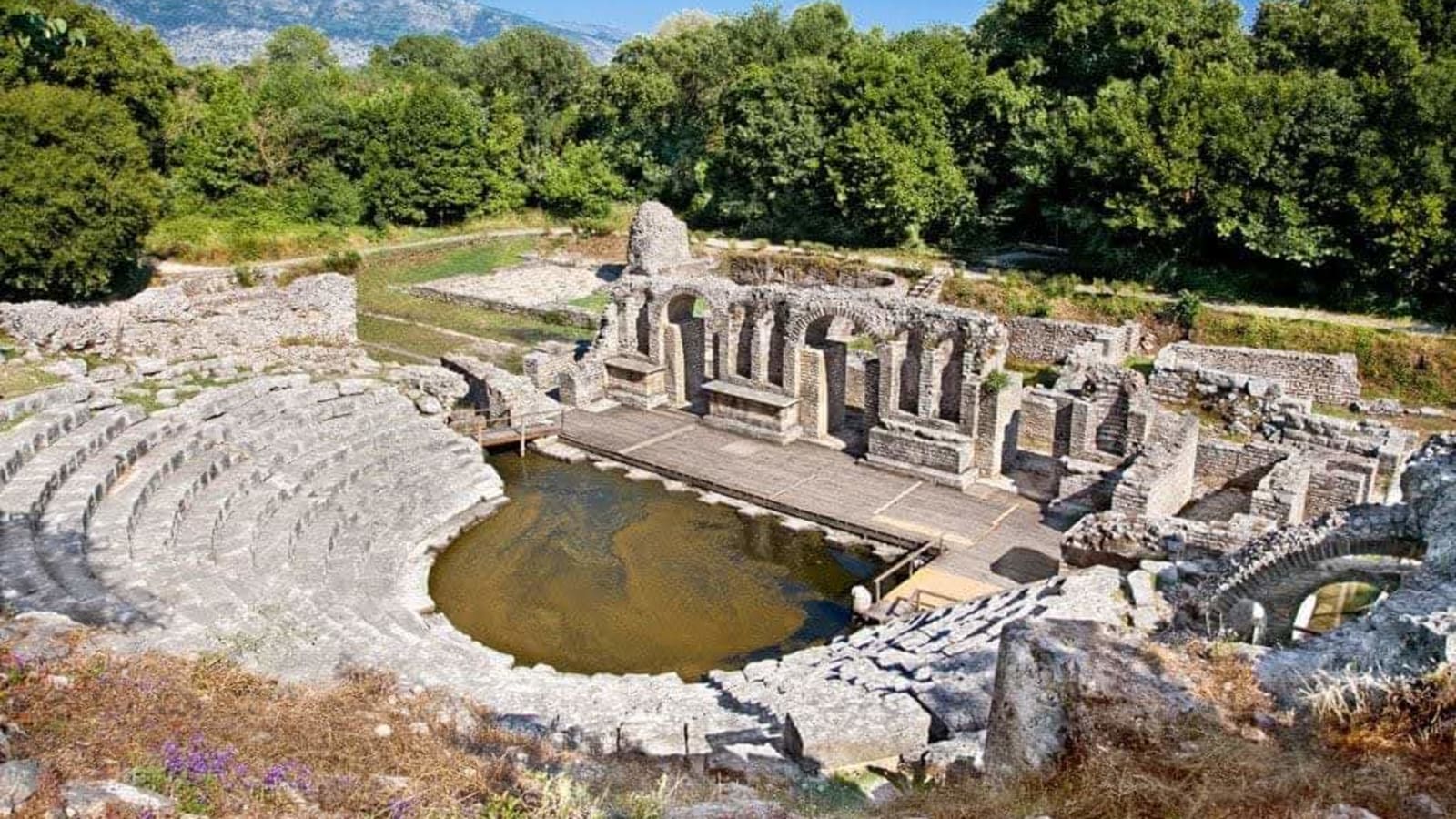
The UNESCO World Heritage Centre places Butrint approximately 20 kilometres from Saranda, and the Butrint Foundation says the journey takes about 30 minutes by car. The ancient city stands on a small hill ringed by Lake Butrint and the Vivari Channel, and UNESCO counts occupation there from prehistory to the 19th century: a city influenced by Greek culture from about 800 BC, a Roman colony from 44 BC, a bishopric from the 5th century and later a Byzantine, Angevin and Venetian town.
What you walk through at the Butrint National Archaeological Park spans all of that: the theatre, which UNESCO singles out among the ancient monuments, the baptistery with its mosaic floor, the Great Basilica of the 6th century, the city walls and gates, and the Butrint Museum in the Venetian castle on the acropolis. Across the water stand the Venetian Triangular Castle on the southern bank of the channel and, at its mouth, the fortress Ali Pasha added in the early 19th century, Ali Pasha's Castle, which is reached by boat.
Without a car, the municipal bus on the Saranda to Ksamil to Butrint line runs from the town stop to the site and back, following the timetable the municipality posts there. The road passes Ksamil and its islands on the way, and on the ridge before the ruins the Lake Butrint viewpoint looks over the lagoon. Butrint is the signature excursion from Saranda, and it has its own guide: the Butrint National Park guide covers the site, the museum and the channel in detail.

The Blue Eye
The Blue Eye, Syri i Kaltër in Albanian, is a karst spring near the village of Muzinë, in Finiq municipality, inland from Saranda. Water wells up from a hole whose depth is still unknown: divers have gone down fifty metres without finding the bottom. The deep blue centre, ringed by green, gives the spring its name, and it is the first source of the Bistricë, a river of about 25 kilometres that reaches the Ionian Sea south of Saranda.
The National Agency of Protected Areas says the spring lies near Muzinë, opposite the village of Krongj, close to the national road from Gjirokastër through Delvinë to Sarandë. By a decision of the Council of Ministers of 26 January 2022, its status changed from natural monument to natural park and the protected area grew from 180 to 293.3 hectares, with oak and plane trees around the pool. The spring dried up for a time in the summer of 2004, and a wildfire burned part of the site in 2017.
By car, the turning is from the Saranda to Gjirokastër road at Krongj. Without one, the municipal board at the town stop carries a daily Saranda to Blue Eye line, and Class Tours runs return vans that wait about an hour at the spring. Because the Blue Eye sits on the road to Gjirokastër, many of the organised days from town combine the two, often with a stop at Lëkurësi Castle above the town. See the Blue Eye place page for more.
Gjirokastër
Gjirokastër stands in the valley of the Drino, 300 metres above sea level between the Gjerë mountains and the river. Its old town is on the UNESCO World Heritage List, inscribed in 2005 with Berat as the Historic Centres of Berat and Gjirokastra and extended in 2008. UNESCO describes a series of two-storey houses developed in the 17th century, a bazaar, an 18th century mosque and two churches of the same period.
Above the town rises the fortress, where the Gjirokastër National Folk Festival is held every five years. The city appears in the historical record in 1336, passed to the Ottomans in 1418, and was designated a museum city in the communist period for its architecture. It is the birthplace of the writer Ismail Kadare and of the communist leader Enver Hoxha.
Give it a full day; several of the tours from town pair it with the Blue Eye on the way. Blue Line Travel runs a daily Gjirokastër trip from its Saranda office to the castle and the Old Bazaar, then the Blue Eye and Lëkurës castle, with entry tickets extra. Albania Minivans Tours makes a 150-kilometre round trip with about three hours in Gjirokastër, stopping at Lëkurës castle, the Mesopotam monastery, the Blue Eye and an Ottoman bridge. By bus, Gjirokastër is on the fare board of Butrinti Travel & Tours, and with a hire car you set your own pace.

Corfu by ferry
Corfu is the one day trip that crosses a border. Finikas Lines and Ionian Seaways both sail daily between Saranda and Corfu and both put the crossing at about 30 minutes on their fast passenger boats, with the car ferries taking longer; Ionian Seaways keeps its Corfu office at the New Port. It is an international crossing with passport and customs checks, so carry your passport or, for EU citizens, a valid ID card, and be at the terminal in Saranda early: Finikas Lines asks foot passengers for at least 40 minutes, Ionian Seaways for an hour.
On the island, the Old Town of Corfu has been on the UNESCO World Heritage List since 2007. UNESCO traces its roots to the 8th century BC and describes three forts designed by Venetian engineers, which defended the Republic of Venice's trading interests against the Ottoman Empire for four centuries and were partly rebuilt under British rule in the 19th century, around a town of mainly neoclassical houses.
Ionian Seaways arranges day excursions on Corfu as well as the crossing, and the tours block below includes a guided day to Corfu Town and Palaiokastritsa by ferry. A foot-passenger ticket is the simple way to go for a day. Taking an Albanian hire car across is another matter: the rental terms ask renters to notify the rental agent in advance of any trip abroad so the documents can be completed, and one Saranda firm, Rental Car Vip Ades, says a car needs its prior written consent and a Green Card to enter Greece.

Up the coast to Lukovë and Borsh
North of Saranda the coast road runs along the Riviera past two villages that belong to Himarë municipality, not to Saranda's. The National Tourism Agency puts Lukovë about 22 kilometres from Saranda and describes small, quiet beaches surrounded by greenery below the village, with the church of Shën Thanasi in its centre and terraced olive groves on the slopes around it.
Further on, Borsh has a beach of about 7 kilometres along the Ionian Sea, backed by hills that rise to around 900 metres. Borsh Beach is reached by a road through the olive groves from the village, and on a rocky height above it stands Borsh Castle, also called Sopot: a fortress first built in the 4th century BC, refortified under the emperor Justinian in the 6th century and worked on again by Ali Pasha. Inside the walls is the ruined 17th century Hajji Bendo Mosque.
Some of the coves on this stretch of coast are easier from the sea. Below the Kakome Monastery of Saint Mary, whose church was painted by Mihal Jerma in 1672, the bay is reached mainly by boat or on foot down a mountain track. Blue Whale Boat Trips stops at Kakome Bay and spends three hours at Krorez beach, and Nemo Boat runs a shared day to the coves from the harbour. If you drive, remember that the rental terms bar hire cars from the unpaved exits down to the beaches.
Himarë and Porto Palermo
Beyond Borsh the road continues to Himarë, a municipality made up of the units of Himarë, Horë-Vranisht and Lukovë, between the Ceraunian Mountains and the sea. Much of the local population along this part of the coast is bilingual in Greek and Albanian.
A few kilometres south of the town, Porto Palermo Castle stands in its bay, west of the road between Vlorë and Saranda, on what was once a small island joined to the shore by landfill. An inscription over the entrance says French engineers built it in 1804 for Ali Pasha: a three-sided fortress with gun bastions at the corners and a domed hexagonal central chamber.
With a car it makes a full day out; without one, a guided day covers it. Joel Travel & Tours runs a six-hour Riviera day north to Borsh waterfall, Qeparo, Porto Palermo castle, Vuno and Himarë, and Taxi Saranda Shehaj sets private routes that take in Porto Palermo. Butrinti Travel & Tours also runs express buses to Himarë.
Phoenice
For the ancient history of the town itself, Phoenice is the site to see. It was the capital of the Chaonians, on an almost impregnable hill above a fertile valley near the modern town of Finiq, and Saranda, as ancient Onchesmos, flourished as its port. Phoenice was the wealthiest city in Epirus and had the strongest walls until the Roman conquest, and it gave its name to the Treaty of Phoenice, which ended the First Macedonian War.
The city is now part of an archaeological park. Excavations began with an Italian mission in 1924, and the theatre was found during the digs of 1980 and 1981; its stage building had a front 30 metres wide. Parts of the city walls and the central plateau were uncovered at the same time.
None of the operators in this directory names Phoenice on its set itineraries, so a car is the practical way to reach it. It pairs naturally with a morning at the Saranda Archaeological Museum in town, which presents finds from ancient Onchesmos and the Chaonian period.
Tours & Day Trips in Saranda
Boat trips, day tours and tickets around the town and the southern coast, via GetYourGuide.

Butrint, the Blue Eye and Lëkurësi in a Day
Pick-up in Saranda or Ksamil for Butrint and the Blue Eye with both entry tickets included, ending at Lëkurësi Castle.
Check availability
Gjirokastër, the Blue Eye and Lëkurësi in a Day
A full day by air-conditioned van from Saranda or Ksamil to Lëkurësi Castle, the Blue Eye and the old bazaar in Gjirokastër.
Check availability
Corfu Town and Palaiokastritsa by Ferry
The ferry across from Saranda port, a guided walk round Corfu's old town and a coach out to the bay at Palaiokastritsa.
Check availability
Private Blue Eye Trip with Kayaking
Private transport from Saranda or Ksamil to the Blue Eye, with the entry ticket, a kayak and the equipment included.
Check availabilityPlanning your day trips
Several of these trips work without a car. The municipal buses reach Butrint and the Blue Eye, Butrinti Travel & Tours serves Gjirokastër and Himarë, the ferry covers Corfu, and boat trips from the harbour and from Ksamil reach the coves up the coast. For the rest, the agencies in town sell set days, among them Saranda Tours, South Tours & Rentals and Rei Tours, and more are under day trips and sightseeing tours.
Some trips pair well. The Blue Eye and Gjirokastër lie on the same road, Butrint and Ksamil on the same stretch of coast, and Lukovë and Borsh on the drive north. A hire car gives the most freedom for Phoenice, the coast road and an early start at Butrint; the getting to Saranda guide explains how cars are handed over in town.
For a base that suits the trips you have in mind, the where to stay guide compares the town centre, Ksamil and the coast to the north, and the beaches guide covers the swimming on the way.